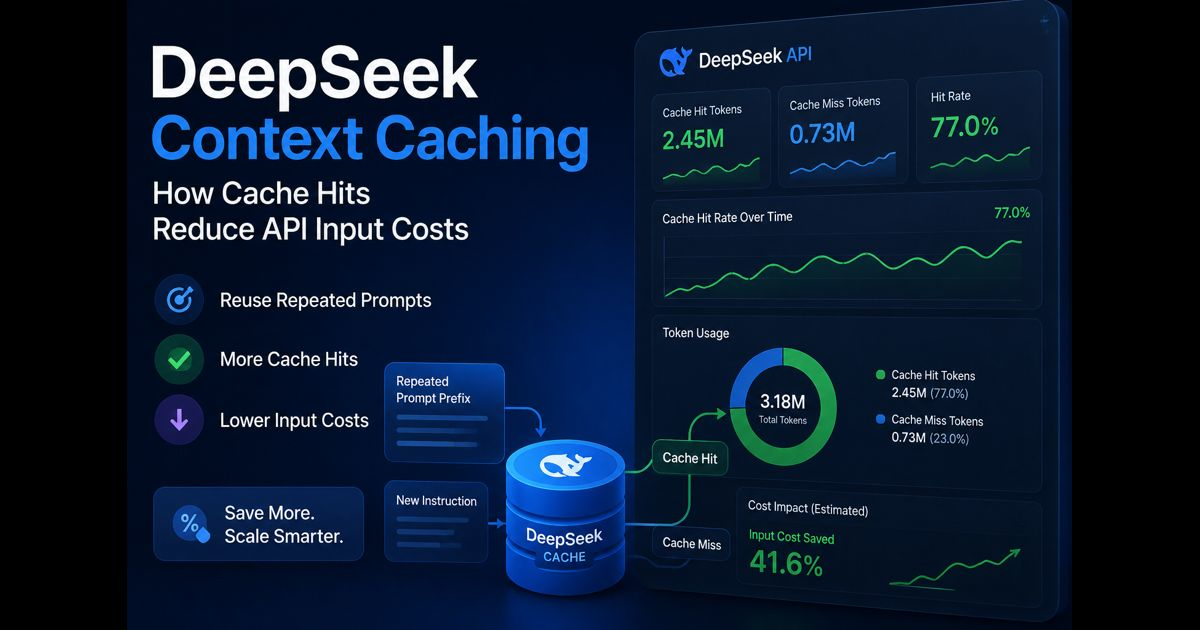
DeepSeek context caching is an automatic API feature that can reduce the cost and processing work of repeated input. When a new request fully reuses a previously stored prompt prefix, DeepSeek can retrieve that matching portion from its disk cache instead of processing it again. The reused portion is counted as a cache hit.
This is most useful when an application repeatedly sends the same large block of text before adding a small, changing instruction. Common examples include a stable system message, product documentation, a policy manual, a codebase excerpt, a long conversation history, or a set of few-shot examples.
Context caching is enabled by default for DeepSeek API users. It does not require a special request parameter or a separate cache-creation call. The important work happens in how requests are structured. DeepSeek’s API documentation explains that cache reuse depends on a fully matching stored prefix, not merely on two requests looking broadly similar.
What a cache hit means
A cache hit occurs when part of a later request exactly matches a persisted cache-prefix unit from an earlier request. DeepSeek can then reuse that portion instead of recomputing it.
A cache miss is the part of the input that must be processed normally because no eligible stored prefix matches it.
For example, consider an application that sends the same 20-page handbook with every request:
System instructions
Company handbook
Product rules
Current user question
If the first three blocks stay in the same order and unchanged, later requests can reuse much of that input. The current user question remains new input, so it is normally processed as a miss.
The benefit is limited to input processing. Output tokens are still generated for each response.
How DeepSeek context caching works
DeepSeek uses disk-based context caching. A request creates cacheable content, and later requests may reuse it when their prefix fully matches a persisted unit. The system does not require developers to manually store or retrieve the cache.
Cache reuse is not the same as receiving an old answer. The model still evaluates the new request and generates a new response. It simply avoids repeating work on eligible input tokens.
DeepSeek documents several ways cache-prefix units can be persisted:
- At the end of user input
- At the end of model output
- When the service detects a common prefix across requests
- At fixed token intervals for long inputs or outputs
This detail matters because cache matching is stricter than “mostly the same text.” A later prompt must fully match a stored unit before that unit can be reused.
Why similar prompts can still miss the cache
The most common reason is an early change in the prompt. Context caching is based on reusable prefixes, so content near the beginning has the greatest effect on later reuse.
These changes can reduce or eliminate cache hits:
- A timestamp or random ID placed before the stable instructions
- Different ordering of tools, examples, documents, or messages
- Editing a stable system prompt for every request
- Changing whitespace, formatting, serialization, or metadata in a way that changes tokens
- Inserting a user-specific value before the reusable material
- Switching models or providers without confirming that the same caching behavior applies
A long prompt does not guarantee a cache hit. DeepSeek states that caching is best-effort, entries can be cleared after inactivity, and the service does not guarantee a 100% hit rate. The historical announcement also notes 64-token storage units, so very short content is not useful for cache reuse. DeepSeek’s context-caching announcement remains a helpful reference for these operating limits.
Design prompts for reuse
The best prompt layout places stable content first and variable content last.
1. Stable system instructions
2. Stable tool definitions
3. Stable reference material
4. Earlier conversation messages
5. Current user input
6. Request-specific metadata
This structure lets multiple requests share the same opening sequence. It also keeps changing material from breaking the reusable portion.
For a document assistant, place the document text before the user’s question. For a support agent, keep the policy library and response rules fixed before the live customer message. For code review, keep the unchanged repository context before the file or task that changes.
Do not add dynamic values to the beginning unless they are necessary there. A date, user ID, session ID, experiment label, or request UUID is usually safer near the end.
A multi-turn conversation example
A normal multi-turn chat naturally creates reusable history.
First request:
[
{"role": "system", "content": "You are a concise technical assistant."},
{"role": "user", "content": "Summarize the deployment guide."}
]
Second request:
[
{"role": "system", "content": "You are a concise technical assistant."},
{"role": "user", "content": "Summarize the deployment guide."},
{"role": "assistant", "content": "…"},
{"role": "user", "content": "Now list the rollback steps."}
]
The second request preserves the earlier conversation exactly and adds new material afterward. That makes the existing conversation prefix a good candidate for reuse.
For a broader explanation of how AI systems use prior context in conversation, see How Modern AI Systems Understand Context, Intent, and Complex User Queries.
Check whether caching is helping
Do not assume that a prompt design works. Inspect the API response usage data.
DeepSeek responses can report:
- prompt_cache_hit_tokens
- prompt_cache_miss_tokens
Track both values alongside request latency and total input-token cost. A healthy repeated workload should show cache-hit tokens rising after equivalent prefixes have been reused.
A simple cache-hit calculation is:
Cache-hit rate = prompt_cache_hit_tokens / total input tokens
Use this as an operational signal, not a promise. A low rate may mean that the initial prompt is changing, requests are reaching the service after cache entries have expired, or the repeated block is too small to produce meaningful reuse.
Calculate the cost impact correctly
Caching changes the price of eligible input tokens, not the full request cost. A useful estimate separates cached input, uncached input, and output:
Total cost =
(cache-hit input tokens × cache-hit input rate)
+ (cache-miss input tokens × standard input rate)
+ (output tokens × output rate)
Always use the current figures published on the official pricing page before estimating a production budget. Models, pricing tiers, and off-peak rates can change. For a foundation in token-based cost planning, readers can also review DeepSeek API Pricing Tokens: Understanding Costs and Value.
Context caching is not local KV cache management
“Context caching” can describe different things in different environments.
With the DeepSeek API, the provider manages eligible disk-cache reuse automatically. Developers structure requests and review usage data, but do not directly manage the provider’s stored cache.
With a self-hosted model, a local KV cache is an inference-memory structure managed by the serving stack. It may affect GPU memory, batching, eviction policy, and latency in ways that differ from DeepSeek’s hosted API behavior.
Do not transfer assumptions between hosted APIs, Azure deployments, model routers, and local inference servers without checking the documentation for that exact endpoint.
Privacy and sensitive input
Cache reuse should never lower the standard for handling sensitive material. Before sending customer records, credentials, health information, legal material, or proprietary code to any AI API, review the provider’s current policies, contractual terms, retention practices, and your organization’s security requirements.
Remove secrets from prompts where possible. Keep API credentials in environment variables or a secure secret manager, never in client-side code or public repositories. Guidance on safer credential handling is available in Mastering the DeepSeek API Key.
Frequently asked questions
Is DeepSeek context caching enabled automatically?
Yes. DeepSeek says its API context caching is enabled by default, with no code change required to benefit from eligible cache hits.
Do I need to add a cache parameter?
No special cache parameter is required for the hosted DeepSeek API feature. Prompt structure and repeated prefixes determine whether reuse is possible.
Does an identical prompt always produce a cache hit?
No. Cache reuse is best-effort. Stored entries may expire, and a request must fully match a persisted prefix unit.
What should stay unchanged?
Keep reusable system instructions, tools, examples, documents, and previous conversation content stable and in the same order. Put current questions and dynamic metadata afterward.
Does caching reuse an earlier answer?
No. It reuses eligible input processing. The model still produces a new output for the current request.
Final thoughts
DeepSeek context caching works best when repeated information is intentional, stable, and placed at the beginning of each request. It can lower input costs and improve responsiveness for conversations, document assistants, support workflows, code analysis, and applications with shared instructions.
The practical rule is simple: preserve what should be reused, append what changes, then monitor actual cache-hit and cache-miss tokens. Official DeepSeek documentation should remain the source of truth for current behavior and pricing.