DeepSeek API pricing is usage-based. You pay for tokens processed in each request, not a fixed monthly API plan. The current API uses three billable categories: cache-hit input tokens, cache-miss input tokens, and output tokens.
DeepSeek applies different rates during peak and off-peak periods. Off-peak prices are half of peak prices, so both the timing of requests and the amount of repeated context can materially change a production bill.
The figures below were checked against DeepSeek’s official pricing documentation on August 2026. Pricing can change, so teams should confirm the live rate card before setting a long-term budget.
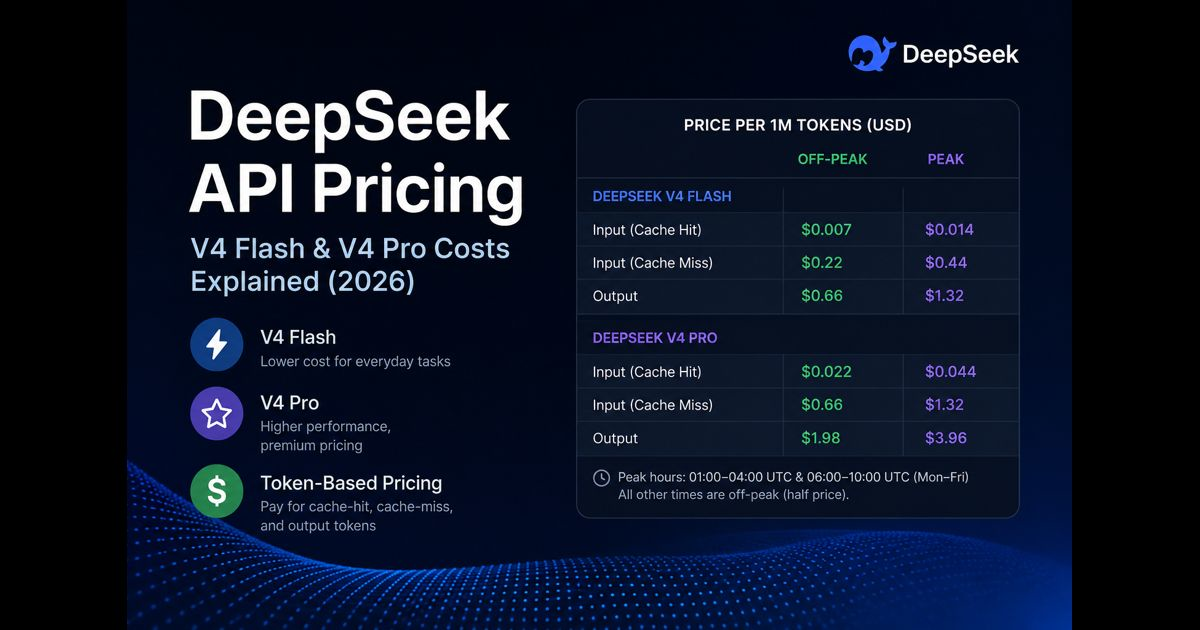
DeepSeek API prices per 1 million tokens
|
Model |
Billing type |
Off-peak |
Peak |
|
DeepSeek V4 Flash |
Input, cache hit |
$0.007 |
$0.014 |
|
DeepSeek V4 Flash |
Input, cache miss |
$0.22 |
$0.44 |
|
DeepSeek V4 Flash |
Output |
$0.66 |
$1.32 |
|
DeepSeek V4 Pro |
Input, cache hit |
$0.022 |
$0.044 |
|
DeepSeek V4 Pro |
Input, cache miss |
$0.66 |
$1.32 |
|
DeepSeek V4 Pro |
Output |
$1.98 |
$3.96 |
|
DeepSeek V4 Flash Vision Exp |
Input, cache hit |
$0.007 |
$0.014 |
|
DeepSeek V4 Flash Vision Exp |
Input, cache miss |
$0.22 |
$0.44 |
|
DeepSeek V4 Flash Vision Exp |
Output |
$0.66 |
$1.32 |
A token is a unit of text used by the model. It is not identical to a word: punctuation, numbers, parts of words, and formatting all contribute to token usage.
Peak hours are 01:00–04:00 UTC and 06:00–10:00 UTC, Monday through Friday. All other times are off-peak. The official rate card confirms that off-peak prices are exactly half of peak prices.
Which DeepSeek model costs less?
For text requests, deepseek-v4-flash is the lower-cost option. It is usually the sensible first choice for summarization, extraction, customer-support drafting, structured responses, routine coding tasks, and high-volume workloads where the application can evaluate output quality.
deepseek-v4-pro costs three times as much per token as Flash at the same time of day. Its higher price is only justified when testing shows it delivers a meaningful improvement for a specific task, such as difficult coding, complex planning, or agent workflows where a better result reduces retries or human review.
Both text models support thinking and non-thinking modes, a 1 million-token context window, and up to 384,000 output tokens. Choosing thinking mode does not create a separate price tier, but it can generate more tokens, which can increase total cost.
For a fuller overview of model capabilities and use cases, see DeepSeek V4.
How DeepSeek API billing works
A request cost should be calculated in three parts:
Request cost =
(cache-hit input tokens ÷ 1,000,000 × cache-hit rate)
+ (cache-miss input tokens ÷ 1,000,000 × cache-miss rate)
+ (output tokens ÷ 1,000,000 × output rate)
A cache miss is newly processed input. A cache hit is eligible repeated context served from DeepSeek’s cache at a much lower input rate. Output tokens are the response generated by the model.
Do not calculate a bill by applying one input price to all tokens. That hides the difference between reused context, new context, and generated output.
DeepSeek V4 Flash cost examples
One new request at off-peak rates
Suppose an application sends 100,000 new input tokens and receives 30,000 output tokens from DeepSeek V4 Flash.
Input: 100,000 ÷ 1,000,000 × $0.22 = $0.0220
Output: 30,000 ÷ 1,000,000 × $0.66 = $0.0198
Total: $0.0418
The same request during peak time costs $0.0836 because each listed rate doubles.
A repeated-context request at off-peak rates
Now suppose the application sends 100,000 input tokens, but 90,000 are cache hits and only 10,000 are new. It again receives 30,000 output tokens.
Cached input: 90,000 ÷ 1,000,000 × $0.007 = $0.00063
New input: 10,000 ÷ 1,000,000 × $0.22 = $0.00220
Output: 30,000 ÷ 1,000,000 × $0.66 = $0.01980
Total: $0.02263
The example shows why output length and fresh input often matter more than the total size of a repeated prompt.
DeepSeek V4 Pro cost example
For 100,000 new input tokens and 30,000 output tokens at off-peak rates:
Input: 100,000 ÷ 1,000,000 × $0.66 = $0.0660
Output: 30,000 ÷ 1,000,000 × $1.98 = $0.0594
Total: $0.1254
Before routing all traffic to Pro, compare accepted-task quality rather than comparing one attractive sample response. A model that costs more per request can still be worthwhile when it reliably prevents failures, repeated requests, or manual correction.
What raises an API bill unexpectedly?
Long conversation history is a common cause. DeepSeek’s chat API is stateless, meaning the application sends the conversation context again with each new request. If an app keeps appending every previous message, input usage can rise quickly.
Long answers also matter. A request with a short prompt can become expensive if it permits a very large generated response. Set max_tokens to the amount your product actually needs.
Thinking mode deserves the same discipline. It can be useful for difficult tasks, but it should not automatically be enabled at the highest effort for short classification, extraction, or formatting jobs.
Tool calls can add costs beyond model tokens because an agent may make several model calls and invoke external services. Track the cost of a completed user task, not only the cost of its first model response.
Practical ways to control DeepSeek API costs
Keep stable instructions consistent across requests so repeated context can benefit from caching. Avoid inserting changing timestamps, random identifiers, or user-specific material before a large shared prompt unless the application needs them there.
Set output limits deliberately. A concise JSON object, a short classification label, and a detailed research response should not share the same max_tokens value.
Use Flash as the default where it meets the quality bar, then route only difficult requests to Pro. This decision should be based on evaluation data from your own task set.
Schedule non-urgent batch-style work outside the weekday UTC peak window when timing is under your control.
Log token usage by model, endpoint, feature, customer workflow, cache status, and time period. The final API response includes usage data, which makes it possible to compare estimated cost with actual consumption.
Before sending live traffic, create and protect a DeepSeek API key. Keep it on the server, rotate it if exposure is suspected, and never place it in browser code or a public repository.
Important model-name update
Use the current API model IDs:
- deepseek-v4-flash
- deepseek-v4-pro
- deepseek-v4-flash-vision-exp
Older names such as deepseek-chat and deepseek-reasoner reached their announced retirement deadline in July 2026. Old tutorials using those names may be outdated even when their code structure appears familiar.
Does DeepSeek offer a fixed monthly API plan?
DeepSeek’s official API documentation describes token-based deductions from topped-up or granted balance. It does not present the V4 API as a fixed monthly subscription with included token quotas.
A web-chat product, reseller, or third-party platform may offer its own subscription, but that is separate from direct DeepSeek API billing. Always identify which service is charging before comparing costs.
Frequently asked questions
How much does DeepSeek V4 Flash cost?
At off-peak rates, DeepSeek V4 Flash costs $0.007 per million cache-hit input tokens, $0.22 per million cache-miss input tokens, and $0.66 per million output tokens. Peak rates are double.
How much does DeepSeek V4 Pro cost?
At off-peak rates, DeepSeek V4 Pro costs $0.022 per million cache-hit input tokens, $0.66 per million cache-miss input tokens, and $1.98 per million output tokens. Peak rates are double.
Is DeepSeek API pricing per request?
No. Billing is based on the input and output tokens processed in each request. Input tokens are billed differently depending on whether they are cache hits or cache misses.
Is DeepSeek Flash cheaper than Pro?
Yes. At the same time of day, V4 Pro costs three times the V4 Flash rate for cache-hit input, cache-miss input, and output tokens.
Can API prices change?
Yes. DeepSeek states that pricing may be adjusted. Check the official pricing page before forecasts, client quotes, or production budget commitments.
Final thoughts
DeepSeek API pricing is straightforward once each request is separated into cache-hit input, cache-miss input, and output. The meaningful cost controls are model routing, context discipline, output limits, cache-aware prompt design, and scheduling flexible workloads during off-peak periods.
Use current V4 model IDs, calculate costs from actual token logs, and treat any third-party pricing table as historical unless it matches DeepSeek’s live official documentation.