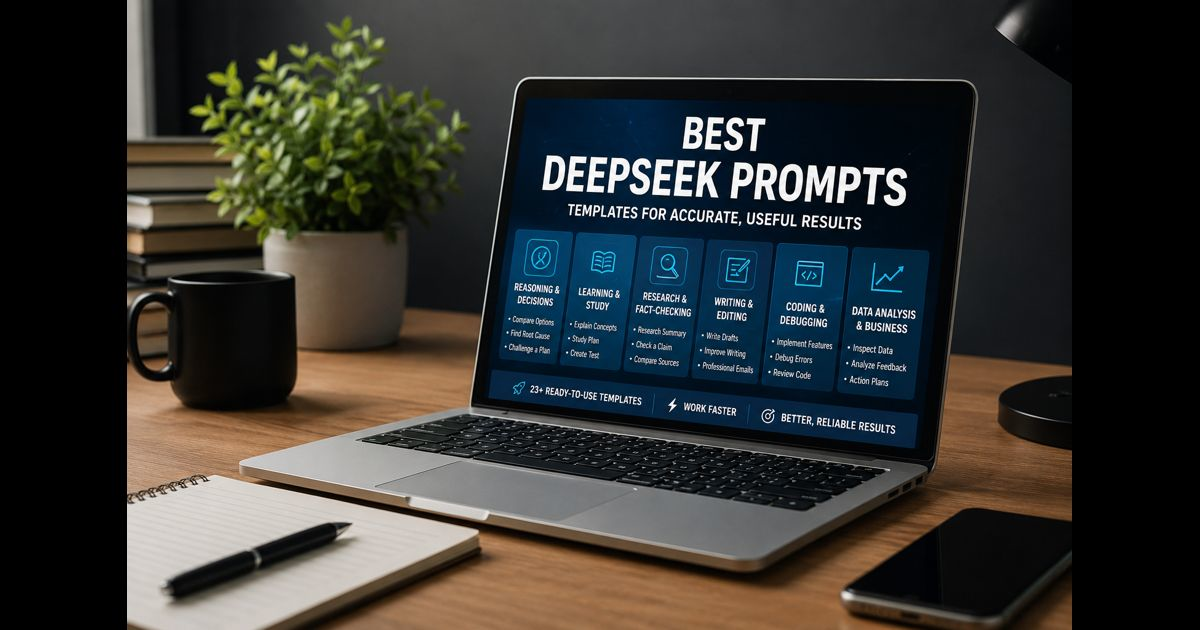
The best DeepSeek prompts define a clear task, supply relevant context, set firm boundaries, request a usable format, and explain how the answer should be checked. A detailed prompt is not automatically a good prompt. It should contain enough information to remove uncertainty without burying the task under unnecessary instructions.
A reliable structure is:
Task:
[State the result you need.]
Context:
[Provide the audience, situation, goal, or background.]
Input:
[Paste the relevant material.]
Requirements:
– [Set the scope, length, tone, rules, and exclusions.]
– Distinguish confirmed information from assumptions.
– Do not invent missing facts.
Output:
[Specify the exact format.]
Verification:
Check the result for accuracy, completeness, and compliance before finalizing.
Not every request needs the complete structure. A translation may require only the text and target language. A business decision, code review, or research summary benefits from context, constraints, and verification.
How to Get Better Results From DeepSeek
DeepSeek performs more reliably when it knows what success looks like. Instructions such as “make this better” leave the model to decide what “better” means. Tell it whether you need greater clarity, shorter sentences, stronger evidence, fewer technical details, or a different structure.
Five elements improve most prompts:
- A precise outcome: Describe the finished deliverable rather than the broad subject.
- Relevant evidence: Supply the document, figures, code, examples, or background the answer must use.
- Clear boundaries: State what must be preserved, omitted, or treated as unknown.
- A defined format: Request a table, checklist, report, email, JSON object, or working code.
- A quality check: Ask DeepSeek to test its answer against the requirements.
Use DeepSeek thinking mode for difficult decisions, mathematical work, debugging, and tasks involving several dependent steps. For rewriting, classification, extraction, and routine summaries, a direct response is usually more efficient.
You do not need to demand a full private reasoning transcript. For important work, request the assumptions, evidence, calculations, tests, and a concise explanation supporting the conclusion. These are easier to inspect and more useful than a lengthy reasoning narrative.
Best All-Purpose DeepSeek Prompt
This template can be adapted for professional, academic, technical, and personal tasks.
Complete the task below using only the relevant information provided.
Task:
[Describe the exact result required.]
Context:
[Explain the audience, purpose, background, and intended use.]
Input:
[Paste the source material, data, or instructions.]
Requirements:
– Address every part of the task.
– Preserve all confirmed facts.
– Do not invent names, figures, quotations, sources, or events.
– Label any necessary assumption clearly.
– If essential information is missing, identify what is needed.
– Keep the response focused on the intended use.
Output:
[Specify the structure and length.]
Before finalizing, check the response against every requirement and correct any conflict.
This works because it separates the job, evidence, limitations, and deliverable. It also gives DeepSeek explicit instructions for handling missing information.
DeepSeek Prompts for Reasoning and Decisions
1. Compare Several Options
Evaluate the following options and recommend the strongest choice.
Decision:
[Describe the decision.]
Options:
[List the available options.]
Priorities:
[List the factors that matter, in order.]
Constraints:
[Budget, deadline, acceptable risk, location, or other limits.]
For each option:
– Identify the main benefits and disadvantages.
– State the assumptions on which the option depends.
– Identify its largest practical risk.
– Score it against each priority using a 1–10 scale.
Recommend one option. Explain the decisive trade-off, the strongest objection to your recommendation, and the first three actions required.
The scoring criteria should reflect the real decision. An unweighted list of advantages and disadvantages may make every option appear equally reasonable.
2. Find the Root Cause of a Problem
Diagnose the most likely root cause of this problem.
Observed problem:
[Describe what is happening.]
Expected behavior:
[Describe what should happen.]
When it began:
[Provide timing and any recent changes.]
Evidence:
[Paste errors, logs, measurements, screenshots described in text, or observations.]
Already attempted:
[List previous fixes and their results.]
Separate possible causes into:
1. Input
2. Process
3. Configuration
4. Environment
5. Human or operational factors
For each cause, state the evidence that would confirm or eliminate it. Rank the three most likely causes, then propose the lowest-risk test that distinguishes between them. Do not recommend a permanent fix until the evidence supports the diagnosis.
This prevents premature solutions based on the first plausible explanation.
3. Challenge a Proposed Plan
Stress-test the plan below before it is approved.
Plan:
[Paste the plan.]
Goal:
[State the intended outcome.]
Constraints:
[List budget, time, legal, staffing, or technical limits.]
Review the plan for:
– Unsupported assumptions
– Missing dependencies
– Failure points
– Unclear ownership
– Unrealistic timing
– Reversible and irreversible decisions
– Risks that would be expensive to discover late
Return:
1. The five most important weaknesses
2. Evidence needed to resolve each weakness
3. Recommended changes
4. A revised sequence of actions
5. Conditions that should trigger a pause or reassessment
DeepSeek Prompts for Learning
4. Explain a Difficult Concept
Teach me [CONCEPT] at a [BEGINNER/INTERMEDIATE/ADVANCED] level.
What I already understand:
[Describe prior knowledge.]
What confuses me:
[Describe the difficult part.]
Explain the concept in this order:
1. A plain-language definition
2. The core mechanism
3. One concrete example
4. A common misconception
5. A case where the concept does not apply
6. Three short questions that test understanding
Avoid analogies that distort the underlying mechanism. Define each necessary technical term when it first appears.
Adding what you already know helps DeepSeek avoid repeating basic material or beginning too far ahead.
5. Build a Practical Study Plan
Create a study plan for [SUBJECT OR EXAM].
Current level:
[Describe your level.]
Target:
[State the result required.]
Available time:
[Hours per day and days per week.]
Deadline:
[Provide the deadline.]
Resources:
[List available books, notes, classes, or tools.]
Build a weekly plan that includes:
– Topics in prerequisite order
– Active recall
– Practice problems
– Spaced review
– A weekly assessment
– Time for correcting mistakes
– A lighter recovery session if one day is missed
End with measurable criteria for deciding whether I am ready to move to the next stage.
A useful plan should measure progress through recall and performance, not hours spent reading.
6. Create a Knowledge Test
Test my understanding of [TOPIC].
Level:
[Specify the level.]
Create:
– Five multiple-choice questions
– Three short-answer questions
– One application problem
Do not reveal the answers initially. After I respond, grade each answer separately, explain the error precisely, and recommend the smallest topic I should review next.
DeepSeek Prompts for Research and Fact-Checking
7. Produce a Source-Bound Research Summary
Analyze only the source material provided below.
Research question:
[State the question.]
Sources:
[Paste the relevant material with a name or number for each source.]
Requirements:
– Answer the question using supported information only.
– Attach the source name or number to every material claim.
– Separate agreement, disagreement, and unresolved uncertainty.
– Note differences in date, sample, method, scope, or definition.
– Do not create citations or fill gaps from memory.
– If the sources cannot support a conclusion, say so directly.
Output:
1. Direct answer
2. Evidence table
3. Conflicting findings
4. Limitations
5. Questions requiring additional evidence
This structure makes unsupported claims easier to detect and reduces the risk of invented references.
8. Check a Claim Before Publication
Evaluate the claim below.
Claim:
[Paste the claim.]
Supporting material:
[Paste the available evidence.]
Determine:
1. What the claim states exactly
2. Which parts are supported
3. Which parts are unsupported or overstated
4. Whether correlation is being presented as causation
5. Whether the evidence is current and applicable to the stated population
6. What additional evidence would be needed
Return one verdict:
– Supported
– Partly supported
– Unsupported
– Misleading without context
– Cannot be determined
Then provide a corrected version that does not go beyond the evidence.
9. Compare Conflicting Sources
Compare the following sources without assuming that the newest or most confident source is correct.
Question:
[State the disputed issue.]
Sources:
[Paste and label each source.]
Create a table showing:
– Main conclusion
– Evidence used
– Publication date
– Population or scope
– Method
– Important limitations
– Possible conflicts of interest
Explain whether the disagreement comes from different evidence, definitions, time periods, methods, or interpretation. Conclude with what can be stated confidently and what remains uncertain.
DeepSeek Prompts for Writing and Editing
10. Write a Useful First Draft
Write a [CONTENT TYPE] about [TOPIC].
Audience:
[Describe the reader and their level of knowledge.]
Purpose:
[Explain what the reader should understand or be able to do.]
Material that must be used:
[Paste confirmed facts, examples, or source notes.]
Requirements:
– Lead with the most useful answer.
– Organize sections around distinct reader needs.
– Explain important limitations and exceptions.
– Use specific examples where they improve understanding.
– Avoid unsupported superlatives, clichés, repetition, and promotional language.
– Do not invent statistics, quotations, experience, or sources.
– Keep each paragraph focused on one idea.
Length and format:
[Specify requirements.]
Before finalizing, remove any paragraph that repeats an earlier point without adding evidence, instruction, or clarification.
11. Improve a Draft Without Changing Its Facts
Edit the draft below for clarity, structure, and precision.
Preserve:
– Every verified fact
– The intended meaning
– Necessary technical details
– Existing links and their anchor text
– The author’s neutral position
Improve:
– Repetition
– Vague wording
– Abrupt transitions
– Excessive sentence length
– Unsupported claims
– Sections that do not help the reader
Do not add new facts, examples, quotations, statistics, or links.
Return:
1. The revised draft
2. A short list of substantive issues that could not be corrected without additional evidence
Draft:
[PASTE DRAFT]
12. Turn Notes Into a Professional Email
Write a professional email from the notes below.
Recipient:
[Role or relationship.]
Goal:
[State the outcome needed.]
Tone:
[Direct, warm, formal, concise, or another tone.]
Notes:
[Paste the facts.]
Requirements:
– Put the purpose in the opening two sentences.
– Preserve all dates, prices, names, and commitments exactly.
– Make the requested action unambiguous.
– Do not invent familiarity or previous agreement.
– Keep the email under [NUMBER] words.
Provide a clear subject line followed by the email.
DeepSeek Prompts for Summaries and Documents
13. Summarize a Long Document Accurately
Summarize the document below for [AUDIENCE].
The reader needs to know:
[List priorities.]
Return:
1. A five-sentence executive summary
2. Key decisions
3. Deadlines and responsible parties
4. Financial or numerical details
5. Risks and unresolved questions
6. Statements that are ambiguous in the source
Do not introduce information that is absent from the document. Preserve qualifications such as “may,” “estimated,” and “subject to approval.”
Document:
[PASTE DOCUMENT]
14. Extract Obligations From a Policy or Agreement
Extract operational obligations from the document below.
For each obligation, identify:
– Responsible party
– Required action
– Deadline or frequency
– Triggering condition
– Exception
– Consequence stated in the document
– Relevant section
Separate explicit obligations from recommendations and ambiguous language. Do not provide legal conclusions.
Document:
[PASTE DOCUMENT]
DeepSeek Prompts for Business and Productivity
15. Convert a Goal Into an Action Plan
Turn this goal into an executable plan.
Goal:
[State the goal.]
Current position:
[Describe resources, progress, and obstacles.]
Deadline:
[Provide the deadline.]
Constraints:
[List time, budget, staffing, or approval limits.]
Create:
1. A clear definition of completion
2. Milestones in dependency order
3. The next physical action for each milestone
4. An owner and deadline for each action
5. Risks and early warning signs
6. A weekly progress measure
7. A fallback plan if the schedule slips
Do not treat vague activities such as “work on strategy” as actions.
16. Analyze Customer Feedback
Analyze the customer feedback below.
Product or service:
[Describe it briefly.]
Feedback:
[Paste comments, tickets, or survey responses.]
Group the feedback by underlying need rather than repeated wording. For each group, report:
– Number of relevant entries
– Customer problem
– Severity
– Frequency
– Evidence excerpts of no more than one sentence each
– Likely operational cause
– Recommended response
– Confidence level
Distinguish isolated preferences from recurring failures. Do not infer customer demographics that were not provided.
17. Prepare a Meeting Brief
Prepare a decision brief for an upcoming meeting.
Decision required:
[State the decision.]
Participants:
[List roles.]
Background:
[Provide relevant facts.]
Options:
[List known options.]
Open issues:
[List uncertainties.]
Create a one-page brief containing:
– Recommended outcome
– Evidence supporting it
– Alternatives considered
– Important trade-offs
– Questions that must be answered
– Decisions that can be deferred
– A proposed agenda
– Actions, owners, and deadlines to record during the meeting
DeepSeek Prompts for Data Analysis
18. Inspect a Dataset Before Drawing Conclusions
Analyze the dataset provided below.
Objective:
[State the business or research question.]
Data:
[Paste the data or describe the attached file.]
First inspect:
– Column meanings and data types
– Missing values
– Duplicate records
– Invalid ranges
– Inconsistent categories
– Possible selection bias
– Whether the data can answer the objective
Then provide:
1. Cleaning steps
2. Appropriate calculations
3. Main findings
4. Alternative explanations
5. Limitations
6. Recommended visualizations
7. Decisions the data does and does not support
Do not treat missing values as zero unless explicitly instructed.
19. Explain a Statistical Result
Interpret the following statistical result for [AUDIENCE].
Result:
[Paste the output.]
Study or business context:
[Describe the situation.]
Explain:
– What was measured
– The magnitude and direction of the effect
– Uncertainty in the estimate
– Statistical significance, if applicable
– Practical significance
– Assumptions behind the method
– What cannot be concluded
Use plain language while preserving numerical accuracy. Do not describe association as proof of causation.
Best DeepSeek Prompts for Coding
20. Implement a Feature
Implement the feature described below.
Language and framework:
[Specify versions if relevant.]
Existing behavior:
[Describe the current system.]
Required behavior:
[List acceptance criteria.]
Inputs and outputs:
[Define types and examples.]
Constraints:
[List allowed dependencies, performance limits, compatibility, and coding standards.]
Before writing code:
– Identify genuine ambiguities.
– State only the assumptions necessary to proceed.
– Describe the chosen approach briefly.
Then provide:
1. Complete code
2. Tests for normal, boundary, and failure cases
3. Setup or migration instructions
4. Security and performance considerations
5. Any acceptance criterion not fully satisfied
21. Debug an Error
Diagnose this error using the evidence provided.
Environment:
[Operating system, runtime, framework, and versions.]
Expected behavior:
[Describe it.]
Actual behavior:
[Describe it.]
Exact error:
[Paste the complete error.]
Relevant code:
[Paste the smallest reproducible section.]
Recent changes:
[List them.]
Already tried:
[List attempts and results.]
Return:
1. Most likely cause
2. Evidence supporting it
3. Minimal diagnostic test
4. Minimal fix
5. Why the fix works
6. A regression test
Do not invent files, functions, settings, or package versions that are not shown.
22. Review Code for Security and Correctness
Review the code below for correctness, security, reliability, and maintainability.
Runtime context:
[Explain where and how the code runs.]
Trust boundaries:
[Describe user input, external services, permissions, and sensitive data.]
Check for:
– Input validation failures
– Injection risks
– Authentication or authorization mistakes
– Exposed secrets
– Unsafe file or network operations
– Race conditions
– Error-handling gaps
– Resource leaks
– Dependency risks
– Incorrect edge-case behavior
For each finding, provide:
1. Severity
2. Exact location
3. Failure or attack scenario
4. Minimal correction
5. Test that proves the correction
Do not report a theoretical issue unless the shown code or stated environment makes it applicable.
23. Generate Meaningful Tests
Create tests for the code below.
Framework:
[Specify the test framework.]
Required behavior:
[List requirements.]
Code:
[Paste code.]
Include:
– Normal cases
– Boundary values
– Empty and malformed input
– Expected failures
– State transitions
– Permission checks where relevant
– A regression test for [KNOWN BUG]
Each test name must describe the behavior it verifies. Avoid tests that only duplicate implementation details. Identify any behavior that cannot be tested without additional dependencies or clarification.
For production integrations, authentication, roles, structured messages, tool definitions, and response controls should be handled through the DeepSeek API rather than repeatedly embedded in every user message.
DeepSeek Prompt for Valid JSON Output
Extract the requested information and return one valid JSON object.
Schema:
{
"name": "string or null",
"date": "YYYY-MM-DD or null",
"amount": "number or null",
"currency": "three-letter code or null",
"items": [
{
"description": "string",
"quantity": "number or null"
}
]
}
Rules:
– Use the exact property names shown.
– Do not add properties.
– Use null when a value is absent.
– Do not guess missing values.
– Return JSON only, without markdown or commentary.
– Ensure the final response parses as valid JSON.
Input:
[PASTE MATERIAL]
When using an API response-format control, the instruction must still define the required JSON content. Syntax enforcement alone does not tell the model which fields or values are appropriate.
How to Repair a Weak DeepSeek Answer
A poor first response does not always require a completely new prompt. Diagnose the specific problem and request a targeted revision.
When the answer is too generic
Revise the answer using the concrete context and evidence already provided. Replace broad advice with actions, examples, or criteria applicable to this situation. Remove any statement that could be given unchanged to a substantially different user.
When facts appear unsupported
Audit the answer. List every factual claim that is not directly supported by the supplied material. Remove unsupported claims or label them as unverified. Do not create citations.
When instructions were missed
Compare the answer against each original requirement in a checklist. Mark every requirement as satisfied, partly satisfied, or missing. Revise only what is necessary to satisfy the missing or partial requirements.
When the response is repetitive
Remove repeated ideas, including passages that restate an earlier point with different wording. Preserve distinct evidence, exceptions, instructions, and examples. Improve transitions after removing repetition.
When the answer is too long
Reduce the response to [LENGTH]. Preserve the conclusion, decisive evidence, important limitations, and required actions. Remove background the intended reader already knows.
Common Prompting Mistakes
Giving a role without a defined task
“You are an expert” does not specify the deliverable, evidence, or limitations. A role is useful only when it establishes a relevant perspective or standard.
Combining unrelated tasks
A request to analyze data, design a strategy, write marketing copy, and produce code can create shallow results. Separate dependent stages and approve the output of one stage before beginning the next.
Asking for current facts without usable evidence
DeepSeek may not have live access to the information required. Provide authoritative material or enable an appropriate retrieval tool. Require the response to identify unsupported gaps.
Supplying conflicting instructions
“Be comprehensive” and “answer in 100 words” may not be compatible. State which requirement has priority or narrow the task.
Requesting a format without defining its contents
“Put it in a table” controls appearance, not quality. Define the columns and the decision each row should support.
Treating self-checking as proof
A verification instruction can catch inconsistency, but it cannot turn missing or inaccurate source material into reliable evidence. Important medical, legal, financial, security, and operational decisions still need qualified human review.
Protect Sensitive Information in DeepSeek Prompts
Do not paste passwords, API keys, authentication tokens, private medical records, financial account details, unpublished business information, or personal data unless the environment and data-handling policy are approved for that use.
Before submitting confidential material:
- Replace names and identifiers with neutral labels.
- Remove secrets and access credentials.
- Share the smallest excerpt needed.
- Check the privacy rules of the service or hosting provider.
- Use an approved local or controlled deployment when organizational policy requires it.
- Review generated code and recommendations before production use.
A well-written prompt cannot compensate for unsuitable data handling.
A Simple Prompt Quality Checklist
Before sending an important request, check whether it answers these questions:
- Is the required result unambiguous?
- Is the necessary context included?
- Are facts separated from assumptions?
- Are scope and exclusions clear?
- Is the output format defined?
- Does DeepSeek know how to handle missing information?
- Is there a meaningful accuracy or acceptance check?
- Has sensitive information been removed?
- Can a human verify the final result?
If several answers are no, improve the instructions before adding more words.
Frequently Asked Questions
What is the best prompt format for DeepSeek?
Use task, context, input, requirements, output, and verification. Simple work may need only the task and output, while high-stakes or technical work benefits from the complete structure.
Should every DeepSeek prompt be long?
No. The prompt should be proportional to the task. Extra instructions can introduce conflict and distract from the actual objective.
Does telling DeepSeek to act as an expert improve accuracy?
Not by itself. Relevant evidence, defined standards, clear constraints, and an inspection step have more practical value than an expert-role instruction alone.
Should I ask DeepSeek to think step by step?
Use thinking mode for genuinely complex work, but request an inspectable explanation, assumptions, evidence, calculations, or tests instead of relying on a lengthy reasoning transcript.
How can I stop DeepSeek from inventing facts?
Provide the necessary source material, restrict factual claims to that material, require missing information to be identified, and inspect important claims before using them.
Why does DeepSeek ignore part of a prompt?
Common causes include conflicting rules, too many tasks in one message, unclear priorities, or excessive background. Divide the work into stages and make the acceptance criteria explicit.
Can the same prompt be reused for every task?
A reusable framework can remain the same, but the context, evidence, constraints, and output should be tailored to the job. A template becomes effective only after its placeholders are replaced with specific information.
Final Thoughts
The best DeepSeek prompts are not the longest or most elaborate. They reduce ambiguity, supply the right evidence, define a useful deliverable, and make errors easier to detect. Begin with a precise task, add only relevant context, establish firm boundaries, and require an output that can be checked.
For consequential work, use an iterative process: create the first result, test it against explicit criteria, identify unsupported assumptions, and revise the weak sections. That approach produces more dependable results than relying on a single impressive-looking instruction.